
THE ESTÉE LAUDER COMPANIES
AI-Powered Scent Advisor
Role
Lead Product Designer
Team
1 lead product designer · 2 ML leads
· 1 front-end engineer · 3 PMs · 1 UX
Researcher
Platform
Mobile, Tablet, Desktop
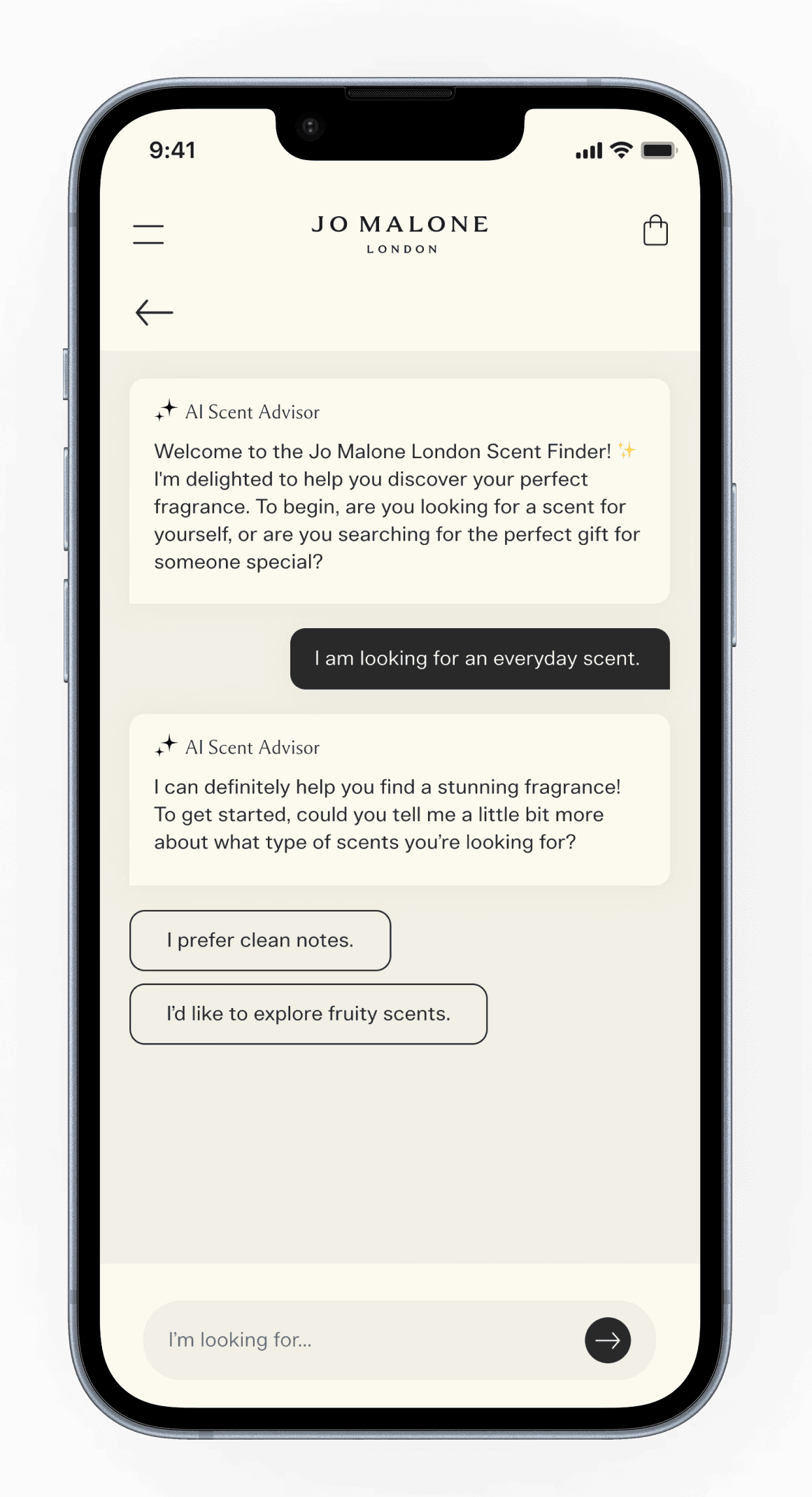
Jo Malone London’s AI Scent Advisor is Estée Lauder Companies’ first GenAI feature release across its brand portfolio.
I led the end-to-end product design of this tool. My team partnered with Google Cloud, leveraging Vertex AI and Gemini LLMs to
build this. The tool uses a guided conversation to deliver personalized scent recommendations, supporting self-purchase and gifting.
Business impact
Selected press




problem + opportunity
Online shopping strips away what makes fragrance
deeply sensory
Without smell, shoppers lose confidence, and there's no shared language to translate feeling into fragrance.
Site Visits
14M+
Convert
279K
Jo Malone's US and UK sites see 14M+ annual visits, yet only 279,000 convert. There was a massive gap between site traffic and purchase intent, and nothing on the market bridging it conversationally.
Solution
Help people explore and purchase fragrance for themselves and as gifts, with the clarity and confidence of shopping in store.
Problem
Without the ability to smell, shoppers lack confidence. There's no shared language between sensory feelings and fragrance families.
strategy
Project Goals
We set out to reimagine how people discover fragrance online, making the process feel as intuitive and evocative as stepping into a Jo Malone store.
1
Increase shopper confidence
2
Translate nuanced preferences
Turn sensory language into structured scent profiles.
3
Deliver intuitive, resonant dialogue
Design a guided experience that feels natural and on-brand.
4
Support self-purchase and gifting
Tailor flows to fit each shopping intent.
5
Build scalable personalization
Establish a foundation for future AI experiences across the Estée Lauder brand portfolio.
research
Competitive Scan
How are others approaching fragrance discovery online?
Companies explored
DOSSIER
Quiz Style Matching
Short quiz to find your "perfume soulmate."
HENRY ROSE
Fragrance Finder
Fragrance Finder quiz matches a signature scent in a few questions.
BATH & BODY WORKS
"Which Scent Are You?"
Playful "Which scent are you?" quizzes, leaning lifestyle over recommendation.
What we learned
Predictable, linear flows
Fixed questions regardless of intent, nothing felt conversational.
Limited emotional depth
Low adaptability
Little support for gifting or nuanced preference capture.
research
User Testing: Round 1
What did we do, and what did we find?
We tested a bare bones version of the model at our internal company store across 50+ participants with pre/post surveys on fragrance knowledge and recommendation quality.

Testing at the company store
50+
Participants at our internal store
30%
Couldn't identify a fragrance family
KEY FINDING
Most users lacked fragrance vocabulary; few could name a scent family or describe notes beyond "fresh" or "warm." They needed a tool that builds confidence through gentle guidance, not jargon.
85%
Relied on in-store sampling to discover scents
Key Finding
Most users lacked fragrance vocabulary; few could name a scent family or describe notes beyond "fresh" or "warm." They needed a tool that builds confidence through gentle guidance, not jargon.
Discovery
Customer Journey Mapping
I led mapping sessions with my PM and engineers on the team to
visualize the full shopping journey, from first visit to conversion.
Discover
Entry via homepage or nav banner
Engage
Conversational flow begins
Recommend
AI suggests up to 3 fragrances
Consider
Explores PDPs or saves via email
Purchase & Retain
Adds to bag, gets personalized follow-ups
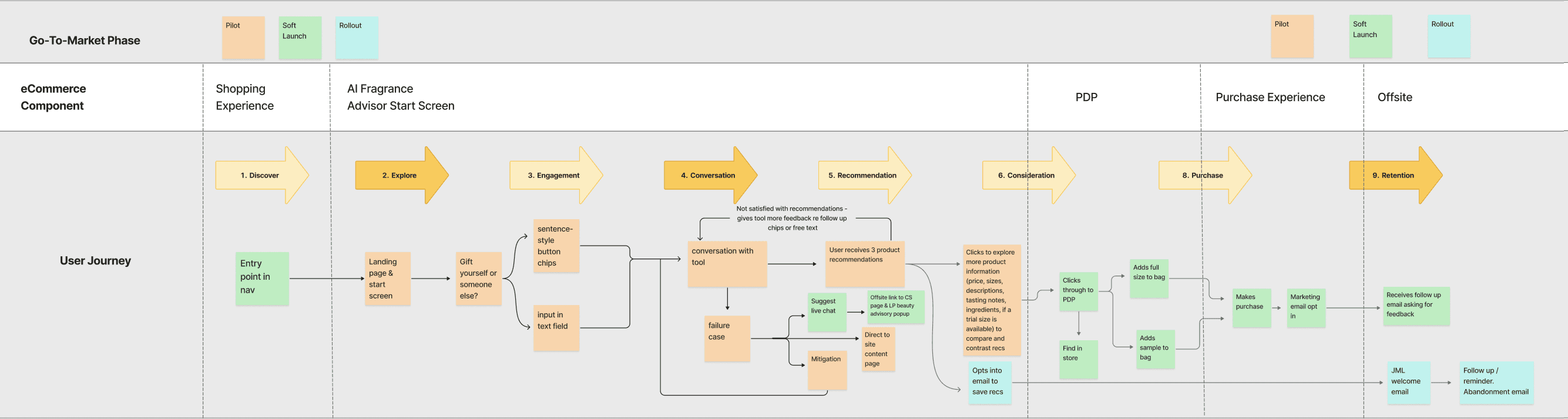
The map became our blueprint for self-purchase and gifting paths, and accounted for mitigation scenarios, like graceful hand-offs to live chat when AI responses fell short.
Discovery
Early Design Explorations
I explored multiple entry points and conversation
structures to balance guidance, simplicity, and brand tone.

Dedicated entry point

Prompt chips
Testing product detail
depth vs simplicity

Different level of
detail in recs

Conversational
framing

Explored input field as entry point
research
Iterative Design & Measurable Gains
After parallel design work, we ran a second round of testing
with key changes: a welcome message on entry and prompt chips to guide users.
What we changed
Welcome message + suggestion chips under messages
Reduced entry confusion


Cut recommendations from 5+ to 3
Users preferred fewer, more focused options


Fallback states for uncertainty
Graceful handling when the AI wasn't confident in a match

Process
Rejected and Accepted Ideas
I refined multiple layouts to balance clarity, tone, and trust.
Early versions relied too heavily on dense product cards and repetitive patterns.
Rejected
Dense product cards created high cognitive load
Missing prompts caused early flow confusion
Repetitive, generic recs undermined trust


Accepted
Clear conversation starters guide users from the start
Layout foregrounds clarity, scent profiles, and personalization


Validation
External User Testing Findings
We parallel pathed external usability testing during this soft launch release
phase in the US & UK with our UXR team to evaluate the UX, consumer
sentiment, and scent-matching accuracy.
12
Participants, US + UK
Novices, gifters, and explorers, balanced by age and tech comfort.
Key task flow
Evaluate trust & clarity
Quick ratings summary
4.5-5/5
Confidence in
recommendations
3.3-4/5
Average purchase intent
3-4/5
Would recommend to others
2/3
launch
What We Shipped
Refined version that includes visual enhancements and expanded flows.
Entry Point + Start Screen
Accessible through the utility bar
and the global navigation.
Information Modal
This modal sets expectations:
what the feature does, doesn't,
and what's coming.
Reducing Effort
Quick prompts lower friction to
steer users toward common queries.
Contextual chips reduce
the manual effort of replies.
Recommendation Set
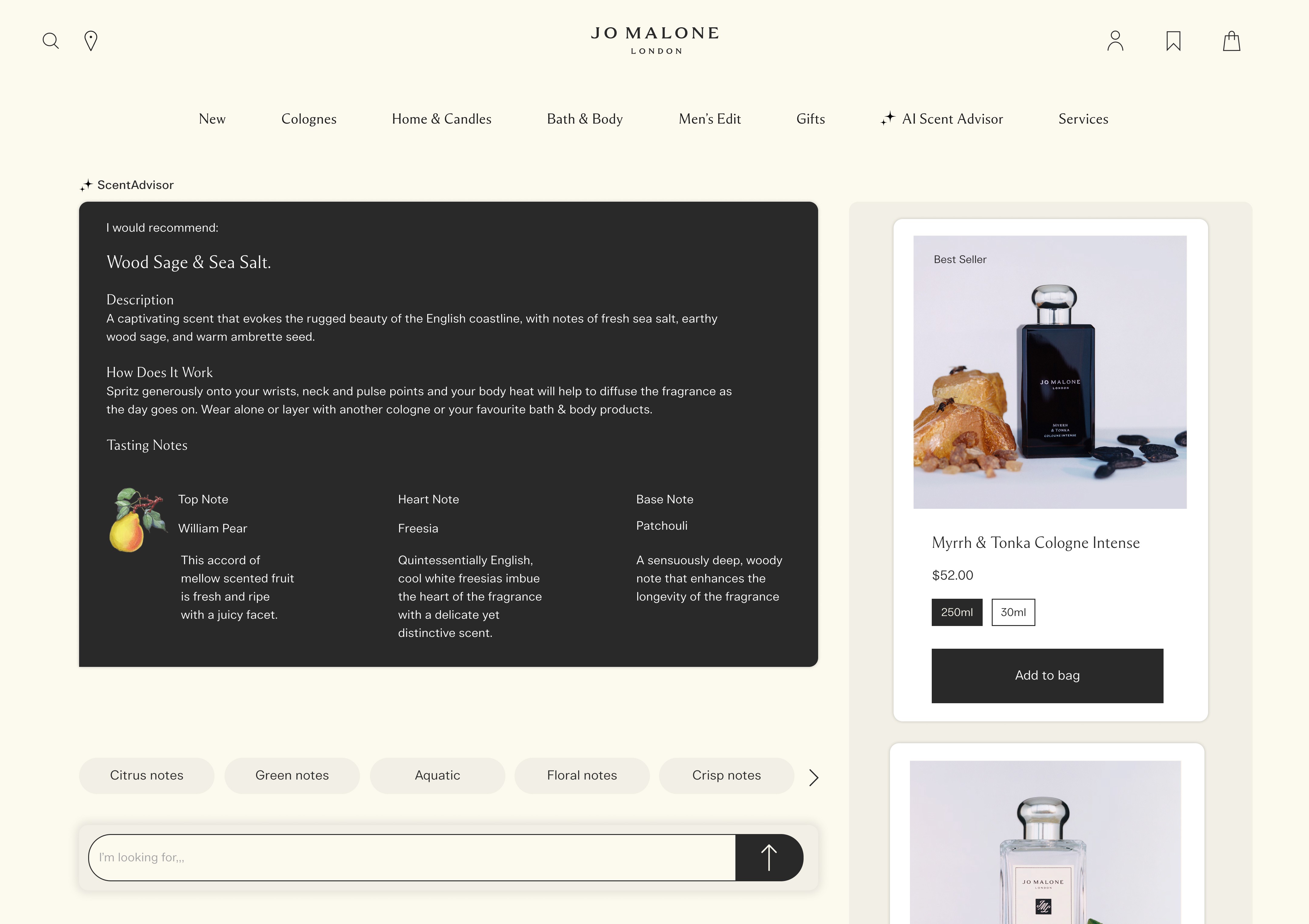
The feature presents up to three fragrance recommendations, with the top match highlighted as the scent most closely aligned with the user's preferences based on the conversation.
Top, heart, and base notes are displayed as pill tags to provide a quick snapshot of each fragrance profile.
A personalized explanation also clarifies why each scent was recommended.
Refreshing Options
Users can refresh their recommendations to reveal three new product options, followed by a question that helps further refine their preferences.
Pathway To Purchase
Each product card includes a "Shop Now" link that opens the product details page in a new tab, allowing users to explore products without losing their conversation history.

Designed for Every Surface
The entry point and conversation layout adapt across mobile, tablet, and desktop, maintaining brand tone and usability at every breakpoint.
Recommendations at Scale
At wider viewports, the recommendation set expands to surface scent profiles, notes, and personalized reasoning, making use of the desktop real estate. This reduces scrolling and supporting faster decision-making.


Graceful Exits
When the model can't confidently match a preference, the experience hands off cleanly, prompting users to explore the full catalogue or start fresh rather than hitting a dead end.
This is one of many fallback states designed, including edge cases.
Business impact
what's next
Scaling the tool
To continue refining the experience, we've identified several opportunities to enhance our MVP that are currently in development.
1
Sharing recommendations
Design email and SMS share flows so users can send their personalized scent recommendations to friends, partners, or themselves.
2
Enhancing product cards
Test richer card variations, including expanded content or a slide-out panel with reviews, size options, and add-to-bag actions.
3
In-store pilot via QR code
Bring the tool into select retail locations through QR codes, letting shoppers access personalized recommendations while browsing in store.